

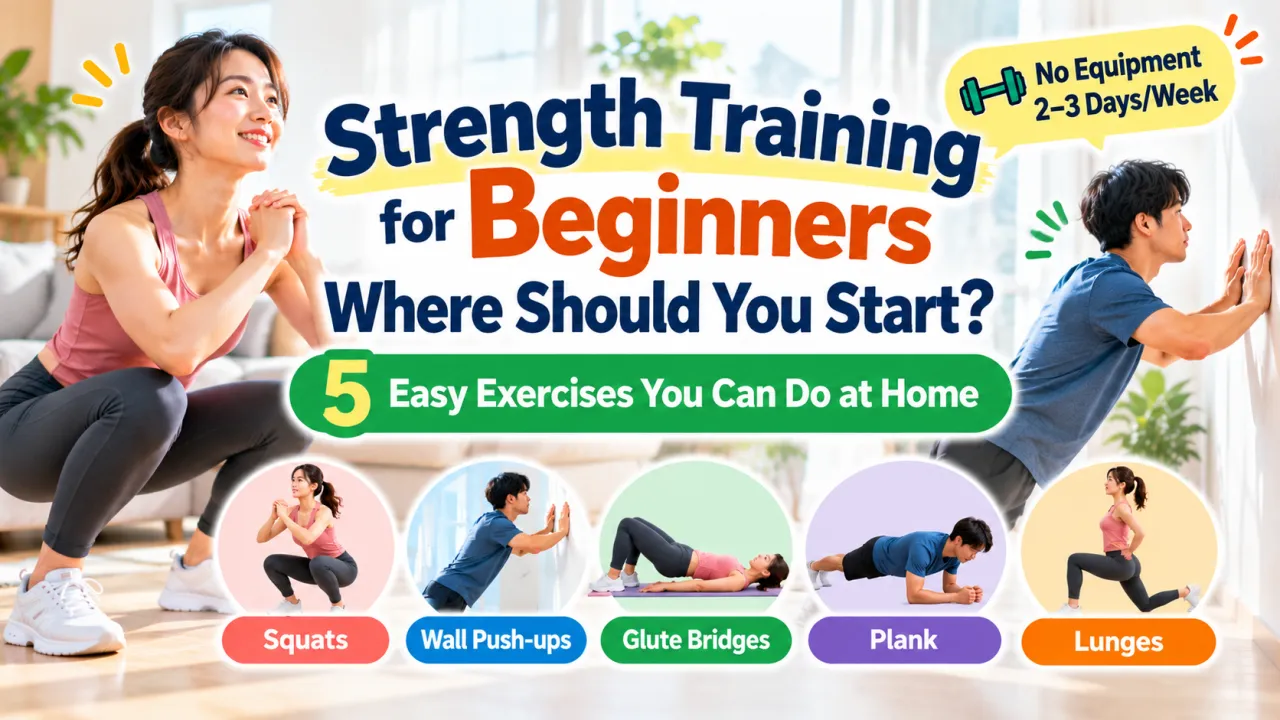
Strength Training for Beginners: 5 Easy Exercises at Home
Writer

Are you thinking about starting strength training but don’t know where to begin? Do you wonder whether you can build strength at home without joining a gym or buying expensive equipment?
Strength training is an effective way to improve muscular strength, support physical function, and maintain long-term health. You don’t necessarily need heavy weights or complicated machines to get started.
In fact, many beginner-friendly exercises use your own body weight as resistance, making it possible to work out in the comfort of your home.
According to the World Health Organization (WHO), adults should perform muscle-strengthening activities involving all major muscle groups on at least two days per week.
Japan’s Ministry of Health, Labour and Welfare also recommends strength training approximately two to three days per week for adults and older adults.
In this guide, we’ll introduce five simple strength training exercises for beginners, explain how to perform them safely, and provide practical advice on repetitions, sets, workout frequency, recovery, and maintaining a consistent routine.
How Should Beginners Start Strength Training?
One of the easiest ways to begin strength training is with bodyweight exercises.
Bodyweight training uses your own body weight to create resistance instead of relying on dumbbells, barbells, or gym machines.
Common examples include squats, push-ups, lunges, and planks.
These exercises can be modified to match different fitness levels, making them useful for people who are new to resistance training.
Before starting, focus on five important principles:
- Start gradually: Choose exercises and repetitions you can perform comfortably.
- Learn proper technique: Prioritize controlled movements over completing as many repetitions as possible.
- Train different muscle groups: Include exercises for your upper body, lower body, and core.
- Allow recovery time: Avoid repeatedly training the same muscles intensely without sufficient rest.
- Progress slowly: Increase resistance, repetitions, or sets as your strength and confidence improve.
You do not need to train for hours or push yourself to exhaustion to begin improving your fitness.
Your first goal should be to establish a safe, enjoyable, and sustainable exercise habit.
4 Benefits of Strength Training
1. Builds and Maintains Muscular Strength
Strength training challenges your muscles by making them work against resistance.
Over time, your body can adapt to this training stimulus, helping improve muscular strength and physical performance.
Stronger muscles can support everyday activities such as standing up from a chair, climbing stairs, carrying groceries, and lifting objects.
Resistance training can benefit younger adults, middle-aged individuals, and older adults when appropriately adapted to their needs.
2. Supports Physical Function and Body Composition
Strength training can help maintain or increase muscle mass, depending on your training program, nutrition, and individual characteristics.
Exercises targeting the legs, hips, abdomen, and upper body can also help develop the strength needed for everyday movements.
However, resistance training does not automatically correct posture or guarantee a particular body shape.
Posture and body composition are influenced by many factors, including anatomy, physical activity, flexibility, nutrition, and lifestyle.
3. Helps With Weight Management
Strength training contributes to physical activity and energy expenditure.
It may also help preserve muscle mass during a weight-management program.
However, doing strength training alone does not guarantee weight loss.
Weight management depends on factors such as overall calorie intake, daily activity, individual metabolism, and sustainable lifestyle habits.
For a balanced approach, consider combining resistance training with regular walking or other aerobic activities and an appropriate diet.
It’s also important to understand that exercises targeting a particular muscle do not selectively remove fat from that area.
4. Contributes to Long-Term Health
Muscle-strengthening activity provides benefits beyond changes in appearance.
Research summarized in public health guidelines associates resistance training with improvements in muscular function and other aspects of health.
Strength training is also associated with a lower risk of certain chronic health conditions and premature mortality.
However, these findings do not mean that strength training guarantees disease prevention.
For long-term health, it is important to consider physical activity alongside balanced nutrition, sufficient sleep, and other healthy habits.
5 Easy Strength Training Exercises You Can Do at Home
The following exercises require little or no special equipment and can be adapted for beginners.
You do not have to complete all five exercises during your first workout.
Start with movements that feel manageable and gradually introduce others as your fitness improves.
1. Squats: Strengthen Your Legs and Glutes
Squats are a basic lower-body exercise that primarily targets the muscles in your thighs and buttocks.
They help train movements similar to sitting down and standing up, making them particularly relevant to everyday physical function.
How to Do a Bodyweight Squat
- Stand with your feet approximately shoulder-width apart.
- Maintain a comfortable, natural position through your back.
- Slowly bend your hips and knees while moving your hips backward.
- Lower yourself only as far as you can comfortably control.
- Push through your feet to return to a standing position.
Beginner starting example: 5–10 repetitions for 1 set.
Focus on smooth, controlled movements rather than squatting as deeply as possible.
If you experience knee or back discomfort, reduce the depth of the movement or stop.
For additional stability, try a chair squat. Use a sturdy chair, gently sit down, and stand back up without rushing.
2. Wall Push-Ups: Strengthen Your Chest and Arms
Traditional floor push-ups can be challenging for beginners because they require considerable upper-body strength.
Wall push-ups offer an easier alternative that allows you to practice a similar pushing movement with adjustable resistance.
How to Do a Wall Push-Up
- Stand facing a sturdy wall.
- Place your palms on the wall approximately shoulder-width apart.
- Step back slightly while maintaining a stable body position.
- Slowly bend your elbows and move your chest toward the wall.
- Push through your palms to return to the starting position.
Beginner starting example: 5–10 repetitions for 1 set.
Standing closer to the wall generally makes the movement easier, while stepping farther away increases the challenge.
Keep your movement controlled and avoid forcing your shoulders or wrists into uncomfortable positions.
As your strength improves, you may progress to incline push-ups using an appropriately stable, secure surface.
3. Glute Bridges: Strengthen Your Glutes and Core
The glute bridge is a floor-based exercise that primarily targets your gluteal muscles.
It also challenges your ability to stabilize your hips and trunk during movement.
How to Do a Glute Bridge
- Lie on your back on a comfortable exercise mat.
- Bend your knees and place both feet flat on the floor.
- Keep your arms relaxed beside your body.
- Gently engage your abdominal muscles and lift your hips.
- Stop before excessively arching your lower back, then lower your hips slowly.
Beginner starting example: 5–10 repetitions for 1 set.
Concentrate on controlled movement and using your glute muscles rather than lifting your hips as high as possible.
If you experience lower-back pain, stop the exercise and seek appropriate advice if symptoms persist.
4. Planks: Strengthen Your Core
The plank is an isometric exercise, meaning your muscles work to maintain a position rather than repeatedly moving through a large range of motion.
It primarily challenges the muscles around your abdomen and trunk.
For beginners, maintaining a comfortable position for a short period is more important than holding a plank for several minutes.
How to Do a Forearm Plank
- Place an exercise mat on the floor and lie face down.
- Position your forearms on the floor with your elbows below your shoulders.
- Support your body on your forearms and toes.
- Gently tighten your abdominal muscles while avoiding excessive arching in your lower back.
- Breathe naturally and maintain the position for a manageable amount of time.
Beginner starting example: Hold for 10–20 seconds for 1 set.
If a full plank is too difficult, try performing it with your knees on the floor.
A shorter plank with controlled form is preferable to a longer plank performed with significant discomfort or poor body control.
Stop if you experience pain, dizziness, or difficulty breathing normally.
5. Lunges: Strengthen Your Legs and Glutes
Lunges are lower-body exercises that place your feet in a staggered position.
They challenge the muscles around your hips and legs while also requiring balance and coordination.
Because lunges can feel more demanding than basic squats, beginners should start with a small movement and use support when necessary.
How to Do a Stationary Lunge
- Stand with one foot forward and the other behind you.
- Hold a secure support if you need help with balance.
- Slowly bend your knees to lower your body a small distance.
- Keep your movement controlled and within a comfortable range.
- Push through your feet to return to the starting position.
Beginner starting example: 5 repetitions per leg for 1 set.
You do not need to lower your back knee all the way to the floor.
If you have knee pain or difficulty maintaining balance, consider practicing squats or another more stable exercise instead.
Lunges are optional. A good beginner routine should be adapted to your abilities rather than forcing you to perform every exercise.
How Many Reps and Sets Should Beginners Do?
When beginning strength training, the number of repetitions you perform should match your current ability and the difficulty of each exercise.
There is no single number that is ideal for every beginner.
One practical approach is to start with approximately 5–10 controlled repetitions for each dynamic exercise and one set per movement.
For static exercises such as planks, begin with a short hold that allows you to maintain good form.
| Exercise | Beginner Starting Example | Main Muscle Groups |
|---|---|---|
| Squats | 5–10 repetitions | Thighs and glutes |
| Wall push-ups | 5–10 repetitions | Chest and arms |
| Glute bridges | 5–10 repetitions | Glutes and trunk |
| Planks | 10–20 seconds | Core |
| Lunges | 5 repetitions per leg | Thighs and glutes |
These amounts are examples for generally healthy beginners, not universal prescriptions. Adjust the exercises to your fitness, mobility, and health.
Once the movements feel comfortable, gradually increase your repetitions or add another set.
You may eventually need to increase resistance or exercise difficulty to continue building strength.
However, there is no need to train to complete muscular failure every time you exercise.
Quality of movement, appropriate effort, and consistent practice are more important than reaching an arbitrary repetition target.
How Many Days a Week Should Beginners Strength Train?
For general health, the WHO recommends that adults perform muscle-strengthening activities involving all major muscle groups on at least two days per week.
Japan’s Ministry of Health, Labour and Welfare recommends strength training approximately two to three days per week for adults and older adults.
For beginners, scheduling two strength-training sessions per week can be a manageable starting point.
You can gradually increase your frequency if your goals, recovery, and experience support doing so.
Example Weekly Workout Schedule
| Day | Suggested Activity |
|---|---|
| Monday | Beginner full-body strength training |
| Tuesday | Rest or light walking |
| Wednesday | Beginner full-body strength training |
| Thursday | Rest or gentle physical activity |
| Friday | Optional light strength training or recovery |
| Saturday | Walking or another enjoyable activity |
| Sunday | Rest or light recreational activity |
This schedule is an example rather than a mandatory training plan.
Allow enough recovery time between demanding sessions targeting the same muscles.
If you experience significant soreness, unusual fatigue, or discomfort, reduce your training load and allow additional rest.
Remember that walking, cycling, and other aerobic activities provide benefits that complement strength training.
A balanced exercise routine should consider both cardiovascular fitness and muscular strength.
What Should You Eat Before and After Strength Training?
Exercise is only one part of building and maintaining muscle.
Nutrition and recovery also play important roles.
Eat Enough Protein Without Ignoring Other Nutrients
Protein provides amino acids that your body uses to build and repair muscles and other tissues.
Good dietary protein sources include:
- Chicken, beef, and other meats
- Fish
- Eggs
- Milk, yogurt, and cheese
- Tofu, beans, and other soy products
However, consuming protein alone is not enough to support a healthy training routine.
Your body also needs sufficient energy, carbohydrates, dietary fats, vitamins, and minerals.
For example, carbohydrates help provide energy for physical activity and replenish energy stores afterward.
Before purchasing protein supplements, consider whether your ordinary meals already provide the nutrients you need.
Protein powders may be convenient for some people, but they are not essential for everyone.
Make Sleep and Recovery a Priority
Resistance training places stress on your muscles, which then adapt during the recovery process.
This is one reason why appropriate rest between demanding workouts matters.
Adequate sleep is also important for maintaining energy, concentration, and general well-being.
Consistently poor sleep can increase feelings of fatigue and make it more difficult to exercise comfortably.
Rather than focusing only on training volume, consider your overall balance of exercise, nutrition, and rest.
5 Common Strength Training Mistakes Beginners Should Avoid
1. Starting With Too Much Intensity
Motivation is helpful, but doing too much too soon may increase the risk of excessive soreness or injury.
Start with manageable exercises and gradually increase the challenge as you become more comfortable.
2. Sacrificing Technique to Complete More Reps
Completing a high number of repetitions is not useful if your movements become uncontrolled or painful.
If your form begins to deteriorate, reduce the repetitions, take a break, or choose an easier variation.
3. Holding Your Breath While Straining
Some people unintentionally hold their breath during difficult strength exercises.
Forcefully straining while holding your breath can cause substantial changes in blood pressure.
For most beginners, maintaining natural breathing and exhaling during the effort portion of a movement is a practical approach.
If you have cardiovascular or blood pressure concerns, seek appropriate medical guidance before beginning resistance training.
4. Continuing Through Sharp Pain
Muscular effort is different from sharp or unusual pain.
If an exercise causes pain in your joints, back, or another area, stop and reassess the movement.
Do not assume that pain is necessary for progress.
Persistent symptoms should be evaluated by an appropriate healthcare professional.
5. Believing You Must Train Every Day
You do not need to intensely train the same muscle groups every day to build strength.
Recovery is an important part of a training program.
For beginners, two or three appropriately planned weekly sessions may be more sustainable than attempting demanding workouts every day.
How to Stay Consistent With Strength Training
Building a strength-training habit requires more than choosing the right exercises.
It also helps to create a routine that fits your schedule and personal motivation.
Try these strategies:
- Choose regular training days: Schedule your workouts like other important activities.
- Keep sessions manageable: Start with short routines you can complete comfortably.
- Track your progress: Record exercises, repetitions, sets, and how you feel.
- Make exercises easier when necessary: Use modifications instead of forcing difficult movements.
- Allow rest: Adjust your routine when you’re tired, sore, or unwell.
Progress does not always mean a visible change in your body.
For example, you might notice that standing up from a chair feels easier, that your movements are more controlled, or that you can complete additional repetitions comfortably.
These improvements can be encouraging signs of progress.
Avoid comparing your fitness journey with someone else’s. Your ideal routine should reflect your own abilities and goals.
Frequently Asked Questions About Strength Training for Beginners
Q. Can I Build Strength at Home Without Going to a Gym?
Yes. Bodyweight exercises such as squats, wall push-ups, and glute bridges can help improve strength without specialized gym equipment.
As you become stronger, you may need to increase resistance or difficulty to continue progressing, but a gym membership is not required to get started.
Q. Should Beginners Do Strength Training Every Day?
No. Beginners do not need to perform intense strength training every day.
The WHO recommends muscle-strengthening activity on at least two days per week, while Japan’s health guidance recommends approximately two to three days per week.
Plan appropriate recovery between demanding workouts targeting the same muscles.
Q. Does a Workout Only Count if My Muscles Feel Sore?
No. Muscle soreness is not a reliable measure of whether your workout was effective.
You can make progress without feeling sore after every session.
Focus on consistent training, controlled movement, gradually increasing appropriate difficulty, and improvements in physical performance.
Q. How Long Should a Beginner Strength Training Workout Last?
The ideal duration depends on your exercises, sets, rest periods, and fitness level.
Beginners can start with a short session that includes a few manageable exercises rather than aiming for a specific number of minutes.
As your ability improves, you can gradually expand your routine.
Q. Can Strength Training Alone Help Me Lose Weight?
Strength training supports overall physical activity and can contribute to weight management, but it does not guarantee weight loss.
Body-weight changes depend on energy intake, activity levels, and other individual factors.
A balanced approach generally combines appropriate nutrition, resistance training, and aerobic activities.
Q. Is Strength Training Safe for Older Adults?
Appropriately adapted strength training can benefit older adults by supporting muscular strength and physical function.
However, exercises should be selected according to individual fitness, mobility, balance, and health conditions.
Older adults who have significant balance difficulties, joint problems, or medical restrictions should seek guidance from an appropriate healthcare or exercise professional.
Conclusion: Start Strength Training at Home With Simple Exercises
You don’t need expensive equipment, advanced techniques, or a gym membership to begin strength training.
Simple bodyweight exercises offer a practical starting point for building strength and developing healthier movement habits.
Here are the five beginner exercises covered in this guide:
- Squats: Strengthen your thighs and glutes.
- Wall push-ups: Train your chest and arms.
- Glute bridges: Strengthen your glutes and support trunk stability.
- Planks: Challenge your abdominal and core muscles.
- Lunges: Build lower-body strength and challenge balance.
Start with manageable repetitions, learn the movements carefully, and allow appropriate rest between training sessions.
For general health, aim to work toward regular muscle-strengthening activity on at least two days each week, adapted to your abilities and circumstances.
Remember that balanced nutrition, adequate sleep, and regular aerobic activity also contribute to a healthier lifestyle.
Your first workout doesn’t need to be perfect. Start with one simple exercise, build confidence, and progress at a pace that works for you.
References and Further Reading
-
World Health Organization – Physical Activity
-
WHO Guidelines on Physical Activity and Sedentary Behaviour – Recommendations
-
Japan Ministry of Health, Labour and Welfare – Strength Training Information Sheet (Japanese)
-
Japan Ministry of Health, Labour and Welfare – Physical Activity and Exercise Guide 2023 (Japanese and English)
Disclaimer: This article provides general educational information about strength training and healthy physical activity. It is not intended to replace personalized medical advice or professional exercise instruction. If you have an underlying medical condition, joint pain, mobility limitations, or exercise restrictions, consult an appropriate healthcare or qualified exercise professional before starting a new program. Stop exercising if you develop chest pain, severe shortness of breath, dizziness, or other concerning symptoms, and seek medical care when appropriate.